
Reference work · French and English
Enneagram Atlas
A tool for coming back to yourself
The different ways of seeing the Enneagram: the richness of the viewpoints, sometimes divergent, of its schools and traditions. What the schools claim and what research shows are kept clearly apart.
A starting point, not a verdict.
To begin: Becoming Yourself The three centres Finding your type without a test Type 5 or type 6?

example
Working name
Becoming Yourself
A short observation, every day. You choose all types, one type, or “I don't know my type yet”.
- All types
- 1
- 2
- 3
- 4
- 5
- 6
- 7
- 8
- 9
- I don't know my type yet
“In a conversation, your level of integration in the moment often matters more than your type.”
School claim
“Level of integration” refers here to a school's model, not a scientific measure. This card is an example, clearly labelled as such.
Ask yourself
In a recent exchange, what played the bigger part: your type, or the state you were in at that moment?
Try
Today, observe an exchange without immediately looking for the other person's type.
Introduction
The Enneagram in brief
The Enneagram is a model that describes nine personality types, often organised around deep motivations rather than behaviour alone. It is drawn as a nine-pointed figure: a triangle and a hexagon inscribed in a circle. Several schools and traditions interpret it differently, sometimes on essential points. Here you will find this diversity of readings. Scientific studies of the model remain limited, and their results are mixed. The pages keep apart what the schools claim and what research allows us to say.
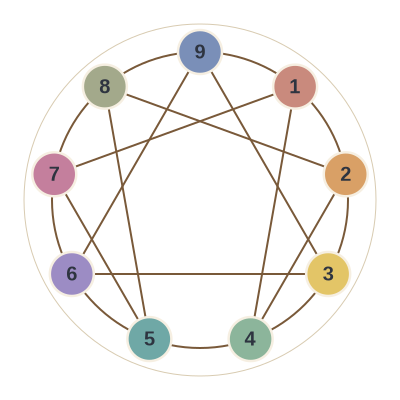
The nine types
One entry page per type
Grouped by centre: body, heart, head. Each type opens onto its articles: motivation, stress, relationships, work, growth.
Body
8 · 9 · 1



Heart
2 · 3 · 4


Head
5 · 6 · 7



Read a little, every day
Guided journeys
Readings of 10 or 21 days, for one type or shared by all types. They are readings, not coaching.
By type







Shared by all types







GlossaryABCDEFGHIJKLMNOPQRSTUVWXYZ
Compare two types
Frequent confusions
One page per pair of types that are often confused: what they share, what sets them apart, and questions to tell them apart.
1 or 21 or 31 or 41 or 61 or 81 or 92 or 32 or 42 or 72 or 82 or 93 or 73 or 94 or 54 or 64 or 95 or 65 or 75 or 96 or 76 or 86 or 97 or 87 or 98 or 9
Our method
What the schools say, what the studies show
Every article separates the schools' claims from measured results. Sources are gathered at the end of each article. Careful wording, with no promises and no diagnosis.
School claim What one or more authors describe, attributed to their school.
Measured Only what a study has measured, with its limits.
Care Sensitive topics: a note at the top of the page and a referral to a professional.